Area
Area of the two-dimensional (two-dimensional) size of a plane (flat or curved) is called area. The region of which area is spoken is often surrounded by a closed curve. It is often measured in M2 (square meter).
Area units:
In Metric:

Area of Square:
Area(A)= (width*height)
= (b*b)
= (b2) Sq,unit
Perimeter of square:


Area = π × a × b
perimeter = 2πSqroot(a2+b2)/2
Area units:
In Metric:
- Square meter (m² ) = SI derived units
- are (a) = 100 square meters
- Hectare ( ha) = 10,000 sq. M
- Square kilometers (km²) = 1,000,000 square meters
- Square foot = 144 square inch = 0.09290304 square meters
- Square yard = 9 square feet = 0.836127 square meters
- Square mile = 640 acre = 2.5899881103 square km (km²)
1. Square:
The square is a special case of rectangle, because it has four right angles. Similarly, it is also a special condition of the quadrangle (rhombus), and parallel quadrilateral.

formula:
Area of Square:
Area(A)= (width*height)
= (b*b)
= (b2) Sq,unit
Perimeter of square:
Perimeter(P)= CD + DE + EF + FC
= (b+b+b+b)
= 4b unit
2. Triangle
The closed shape surrounded by three simple lines is called a triangle or triangle. The triangle has three sides and three angles. Triangle is the smallest polygon. Based on the measurements of these sides and angles, the triangle has been classified differently.

Area of Triangle:
Area(A)= 1/2(base*height)
= 1/2( a*b) Sq. unit
Perimeter of Triangle:
perimeter= a*b*c
3. Circle:
The point of points at equal distances from a certain point is known as the path circle. This fixed point is called the center of the circle. And the distance of the center and point path is called the radius of the circle.
leading strand:
1.The angle transferred to any point of the perimeter by the diameter of the circle is 90 degrees.
2. It is also the equinox of the chord that is inserted from the center on the chord.
3. The sum of angles in front of a cyclic quadrilateral is 180 degrees.
4. The tangent lines drawn on a circle from an external point are equal.
5. All the radiuses of the same circle are the same.

Area of Circle:
Area(A)
=
π
r
2
Pi(π)= 3.14
r= radius( The radius is half the diameter)
perimeter of circle:
perimeter (P) = 2πr
4. Rectangle:
A quadrilateral with four intersections is called a rectangle.
Rectangle Features:
- The opposite sides of the rectangle are accessories and parallel.
- The rectangles are both diagonal accessories.
- Diagonals of rectangle subdivide each other.

Area of Rectangle:
Area(A) = length x width
= a*b Sq. unit
perimeter of rectangle:
perimeter(P) = 2 (length + width)
= 2(a*b)
Diagonal length(d) =
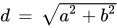
Radius of circumflex
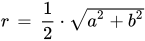
5. Parallelogram:
A pattern of geometry whose face faces parallel. It is called a parallelogram.
Features of Parallel Quadrilaterals:
- The faces facing one face are equal and parallel.
- Diagonals subdivide each other.
- A frontal angle is equal to
- Diagonals endorse an opposite angle.
- Each square is a quadrilateral.
- Each rectangle is a parallelogram.
- Every quadrilateral is equal to parallelogram.

Area of parallelogram = Base * Distance between parallel sides
= b* h
perimeter of a parallelogram = 2(b+h)
6. Trapezoid :
The two sides of the quadrilateral that are unequal and parallel are called parallel quadrilateral.

Area:
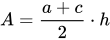
Dimensions:

Height:

(for a < c ),

Where

(for c < a ),

जwhere


Distance from side c to nucleus (area center):
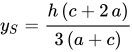
Diagonal:


7. Ellipse:

perimeter = 2πSqroot(a2+b2)/2
Comments
Post a Comment